Free delivery in Nairobi on orders over KSh 10,000
    iTey StoreiTey Store
    Home/iTey Magazine/How to Fund Binance from Kenya (Without USDT P2P)
    How to Fund Binance from Kenya (Without USDT P2P) — Binance | iTey Store Kenya
    12 May 2026
    BinanceCryptocurrencyVirtual VisaKenyaM-PesaCrypto Funding

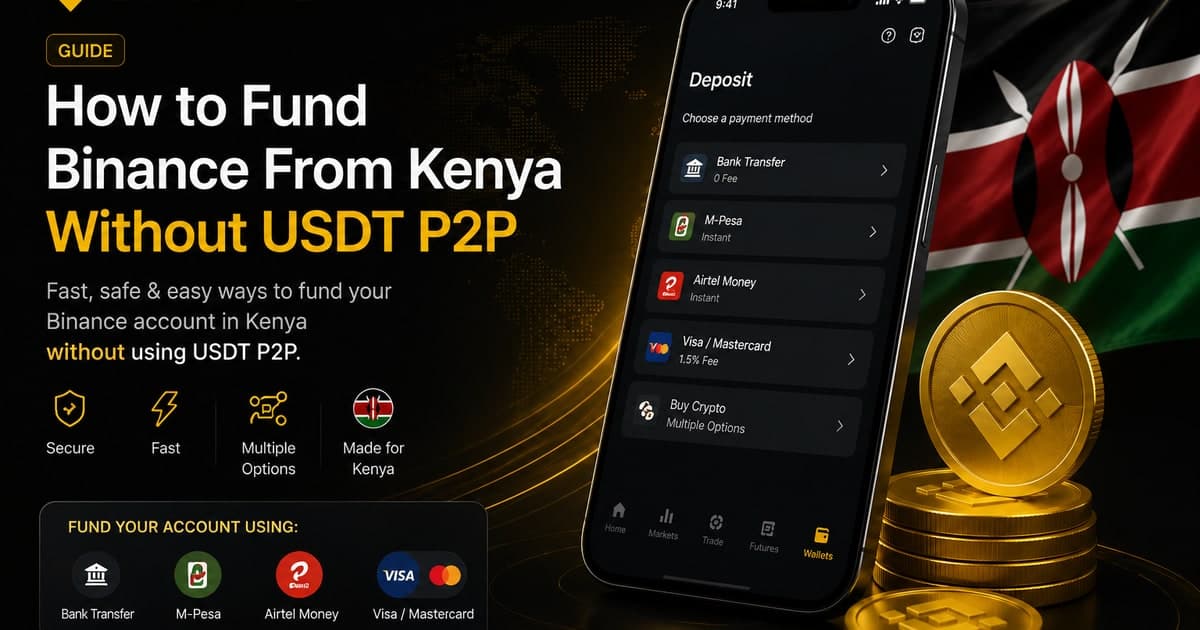
    How to Fund Binance from Kenya (Without USDT P2P)

    Funding a Binance account from Kenya usually means one thing: USDT P2P. You browse buyers on Binance P2P, send M-Pesa to a counterparty, they release USDT to your Binance wallet, you trade from there.

    It works — most of the time. The problems start when it doesn't:

    • Counterparty disputes that lock your USDT for hours or days
    • "Reversed" M-Pesa transactions that get your bank account flagged for fraud review
    • Scam buyers who file fake claims after you've released crypto
    • P2P prices that drift 2–4% above the spot rate when liquidity is thin

    There's a cleaner path: load a Binance card directly from a Virtual Visa card funded by M-Pesa. No P2P counterparty, no holds, no fraud-flag risk. This guide walks through it.

    Why your Kenyan card fails

    The payment processor (Stripe for almost every modern SaaS) filters cards through anti-fraud layers, one of which checks the BIN (Bank Identification Number). Cards issued by Kenyan banks frequently fail this scoring — especially virtual/prepaid cards, cards where the billing country doesn't match the card-issuing country, and cards that haven't been used internationally before.

    The card itself is fine. The balance is fine. The block is upstream and you can't fix it from your end.

    Your three real options

    Option 1: Borrow a foreign card

    Use a friend's or relative's US/UK card. It works — but you're tying your Binance account to someone else's billing. When their card expires or they revoke access, your tool stops working mid-task. Bad foundation.

    Option 2: Wise or Revolut virtual card

    Both offer USD virtual cards, but their KYC requirements are tough for Kenyan residents. Revolut isn't officially available in Kenya, and Wise's US balance feature requires SSN verification. Workable for some, friction-heavy for most.

    Option 3: Virtual Visa card (recommended)

    Virtual Visa is a regulated Uruguay-based fintech that issues Visa-branded virtual prepaid cards specifically designed for international subscription services. You pay in KES from Kenya, receive the card details by email in seconds, then use them like any other Visa card.

    Note: iTey Store no longer sells virtual dollar cards. We stocked them until customers kept struggling with the redemption step, and we would rather tell you that than sell you something that frustrates you. The method below still works — you just buy the card from a virtual-card provider that accepts Kenyan customers, not from us.

    Step-by-step: Binance via Virtual Visa

    1. Get a virtual dollar card. Use a virtual-card provider that accepts Kenyan customers and issues a Visa or Mastercard number you can load in KES. Check their fees and funding methods before you pay — the FX margin is where these services make their money.
    2. Check your email. Your card details arrive in seconds — a 16-digit card number, expiry date and CVV — work exactly like a regular Visa for online checkouts, with no app, sign-up or verification needed.
    3. Add the card to Binance. Go to binance.com/en/my/wallet/account/fiat, find your billing settings, and add the Virtual Visa card details. For billing address, use a US ZIP code such as 10001 if a billing address is required.
    4. You're in. Your funding lands in Binance within minutes. From there you trade or transfer as normal.

    Funding cost

    • A $100 virtual dollar card, bought in KES: varies by provider
    • Net USD into Binance wallet: ~$100 (less Binance's card processing fee, typically 1.8–2%)
    • Virtual card FX margin: ~3–5%

    Compare to USDT P2P at 2–4% above spot plus the time spent finding a trustworthy counterparty. For one-off funding the card route is competitive; for serial high-frequency trading USDT P2P still wins on raw cost when it works smoothly.

    What else this card pays for

    Once you have a Virtual Visa card, the same card works at:

    • ChatGPT Plus ($20/month)
    • Claude Pro ($20/month)
    • Cursor ($20/month)
    • Perplexity Pro ($20/month)
    • Spotify Premium
    • Netflix
    • Binance, Bybit, and other crypto exchanges
    • Apple App Store and Google Play (with regional billing set accordingly)
    • Any international online merchant that accepts Visa

    One Virtual Visa card unlocks the entire layer of global software that's otherwise gated off from Kenyan-issued cards.

    Frequently asked questions

    Is crypto trading legal in Kenya?

    Cryptocurrency is not banned in Kenya, but it's also not regulated by the Central Bank as legal tender. The Capital Markets Authority issued caution notices but no outright prohibition on Kenyans trading crypto. Most Kenyans use international exchanges (Binance, Bybit) under their personal accounts. This guide is informational; do your own research before trading.

    Why not just use M-Pesa to USDT P2P?

    You can, and many Kenyans do. The trade-offs: USDT P2P is faster and cheaper than card funding when it works smoothly, but the P2P market exposes you to scam counterparties, frozen funds during disputes, and reversed M-Pesa transactions that can flag your bank account. For larger amounts or for users who've been burned by P2P before, the card route via Virtual Visa is worth the small premium.

    How much can I fund with one Virtual Visa card?

    Binance has card-funding limits per-transaction that vary by region and account level. With a $100 Virtual Visa card (KSh 18,500) you can top up your Binance wallet in one go. For larger amounts, buy the highest denomination you need — or use several cards one after another, since each card works independently for its full value.

    Can I withdraw from Binance back to M-Pesa?

    Yes — Binance P2P sell-side or direct USDT to a Kenyan crypto-to-M-Pesa partner works for withdrawals. The funding direction (M-Pesa → Virtual Visa → Binance) is the one where the workaround is most useful, because it avoids counterparty risk on the way in.

    Can iTey Store sell me the card?

    No — not any more. We stopped stocking virtual dollar cards because too many customers hit trouble at the redemption step, and a product that generates support tickets instead of happy buyers is not worth selling. This guide stays up because the method still works; we simply are not the place you buy the card.

    Can I get a refund if I change my mind?

    If we fail to deliver the card, you get a full refund via the original payment method. Once the code is delivered and visible in your email, it's a redemption code we cannot recall — refunds aren't possible at that point.

    Is Virtual Visa legal in Kenya?

    Yes. Virtual Visa is a regulated fintech operating in over 70 countries. The cards are issued under Visa's normal network. Kenyans can hold a Virtual Visa account and use the virtual cards freely for any legitimate online purchase.

    While you are here

    iTey Store is a Nairobi shop, not a finance company. What we do sell is genuine tech — iPhones, Samsungs, Macs, PlayStation and Xbox — with full manufacturer warranty, M-Pesa at checkout, and free same-day delivery in Nairobi.

    See iPhone prices in Kenya →

    Ready to buy?

    Free delivery in Nairobi. Genuine products. Manufacturer warranty.

    Get price drops on WhatsApp

    New stock, real price drops, and early access to pre-orders. A few messages a month — never daily spam.


    By adding your number you agree to receive WhatsApp messages from iTey Store. We never share your number, and you can opt out any time. See our privacy policy.